The Imprisoned Thunder
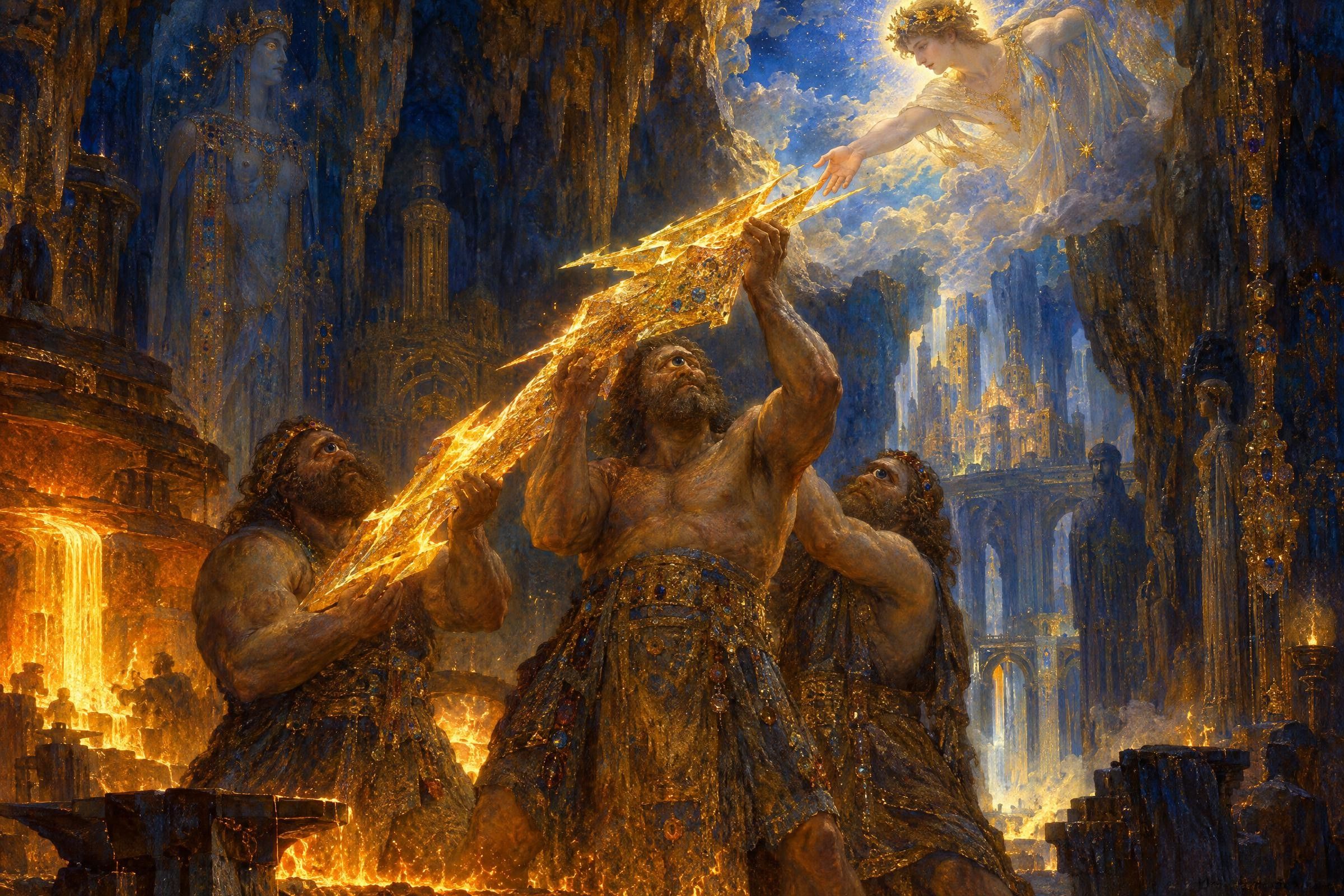
Before there were gods on Olympus, there was only the Sky lying over the Earth, and the Earth bore him children. Some were Titans. Some were giants with a hundred hands. And three were smiths, each with a single round eye in the middle of his brow: Brontes, whose name is Thunder; Steropes, whose name is Flash; and Arges, whose name is Brightness.
Ouranos looked at his children and did not like what he saw. So as each was born he pressed it back down into the dark of the Earth and held it there, and would not let it see the light. The Sky that had fathered the thunder would not let the thunder out.
Gaia groaned under the weight of them. She made a sickle and gave it to her son Kronos, and Kronos cut his father away from her, and the Sky withdrew to the far height where he has stayed ever since, distant and silent. But when Kronos took the throne, he did not free his brothers. He feared them as his father had, and the smiths stayed bound in the deep.
It was Zeus who went down for them. When he made war on Kronos, Earth told him he could not win without the prisoners below, so he broke their chains and brought them up into the light. In their gratitude the smiths forged him the thunderbolt — thunder, flash and brightness, their own three names beaten into one weapon — and put it in his hand. With it he won the war and the sky.
From then on lightning fell where Zeus willed, and no one else could say where that would be. It split an oak on one hill and left the next untouched. It struck a shepherd’s field in a clear summer and passed over the temple that had prayed for it. Where it came to earth, the ground was fenced and left unbuilt, set apart for the god who had chosen it, because nobody else had.
Ouranos never held the bolt. He held only the power to make it, locked away where it could do nothing at all. The lightning belonged to whoever let it out.
The trading concept
Convexity and the positive Black Swan. Some events are rare, cannot be forecast, and pay out far beyond anything that came before them. They fall like lightning: not on the field that deserves it or predicted it, but on whatever field happens to be standing open when the bolt comes down.
A long, out-of-the-money option is a piece of that open ground. Its cost is small and known in advance; its payoff, on the rare day the strike lands, can be many times what was paid. That asymmetry is convexity. No one can say which option, or which season, will be struck. The only choice anyone actually has is whether to be exposed when it happens.
The Sky’s own story is the warning. A system that locks away its sudden, disruptive possibilities, because they are frightening or strange, does not become safe. It simply gives up the thunder to whoever is willing to let it out.
Its shadow → Semele Asks to See the God: the same bolt that rewards the open field consumes the one who asks to receive all of it at once.
Further reading
- Hesiod, Theogony — the birth of the Cyclopes, their imprisonment by Ouranos, and their gift of the thunderbolt to Zeus.
- Apollodorus, Library, Book 1 — Ouranos casts the Cyclopes into the depths; Zeus frees them in the war against the Titans.
- Mircea Eliade, Patterns in Comparative Religion — the sky god who withdraws from the world.
- Nassim Nicholas Taleb, The Black Swan — rare, unpredictable events with outsized consequences.