The Offering
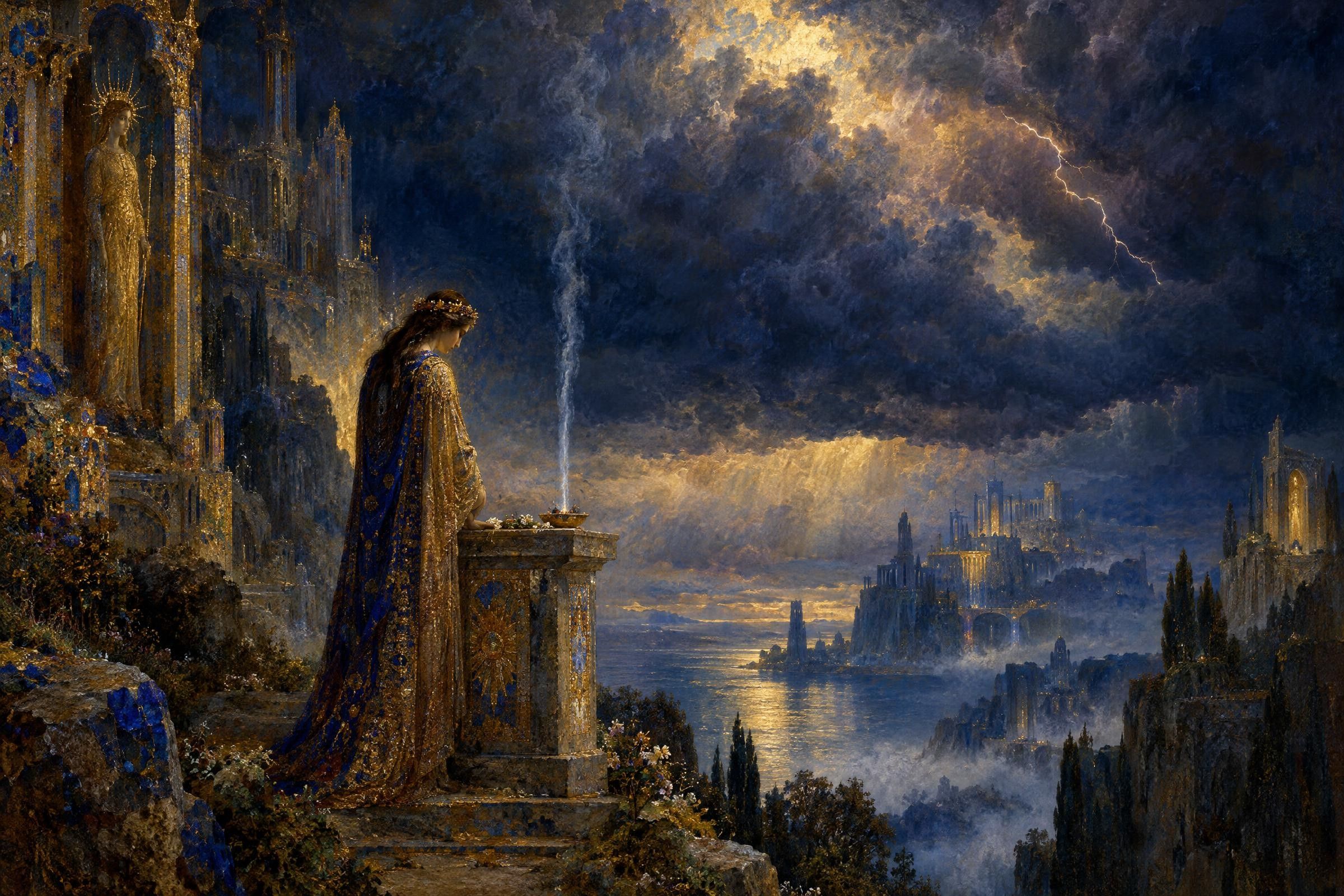
Mortals could not command the gods. They could not summon the rain or aim the lightning or order the harvest to come in. What they could do was offer.
So on a hill above his fields, a man built a small altar of stones. At every new moon he climbed to it with a portion of what he had — never the whole flock, never the whole granary, only a share he had set aside for the purpose. The first morsel went to Hestia’s fire, as it always did. The rest he burned on the altar, and the smoke went up into the open sky, and he spoke the old words that every household knew: I give, so that you may give.
Nothing came back. The next moon he climbed again, and burned another portion, and nothing came back then either. The sky stayed as it had always been — vast, indifferent, keeping its own counsel. The gods did not owe him. The offering was not a purchase, and the smoke was not a contract. It was a gift, and a gift can go unanswered.
His neighbours laughed at him. Some thought him a fool to burn good fat for nothing. Others asked why, if the gods wanted offerings, he did not give everything at once and demand the favour outright. But he had watched men try that. The gods did not come faster for a larger fire, and the men who had burned the whole flock had nothing left to offer when the next moon rose.
So he kept to his measure. A small portion, the same each time, given freely and given again. He did not ask when. He did not ask how much. He asked only to be remembered, and he made sure he was still standing there, at his altar, whenever the god might choose to look.
And one year, without warning, the god looked. A storm broke over the hills that no one had foreseen, and the rain that followed was the richest in living memory, and his fields, which had been planted and tended and waiting, were the ones that drank it. The favour was larger than all his offerings together. It had not been bought. It had simply found him in the place he had been keeping ready for it.
The trading concept
The premium. An option premium is an offering. It is small, it is fixed in advance, and it is paid again and again. What it buys is not an outcome but exposure — the right to be standing in the open when the strike comes. Most premiums are burned and nothing comes back. That is not a failure of the approach; it is the approach.
The loss on any one offering is known before it is made: the portion on the altar and nothing more. What can come back is not bounded. Fixed risk; unbounded reward.
Two errors lie on either side. One is to stop offering after a run of silence — and to be absent on the day the sky finally answers. The other is to try to force the favour with one enormous sacrifice, which the sky does not honour any faster, and which leaves nothing for the next moon.
Its shadow → Semele Asks to See the God: the offering is sized to survive the god’s answer, and the one who asks for everything at once is consumed by it.
Further reading
- Homer, Iliad, Book 1 — Chryses reminds Apollo of the offerings he has burned and asks for favour in return.
- Hesiod, Theogony — the division at Mekone, and why mortals burn the bones and fat for the gods.
- Walter Burkert, Greek Religion — sacrifice and the reciprocity between mortals and gods.
- Nassim Nicholas Taleb, Antifragile — convexity and small, bounded exposures.