Phaethon's Chariot
The shadow ofThe Founder's Sky and Achilles' Choice
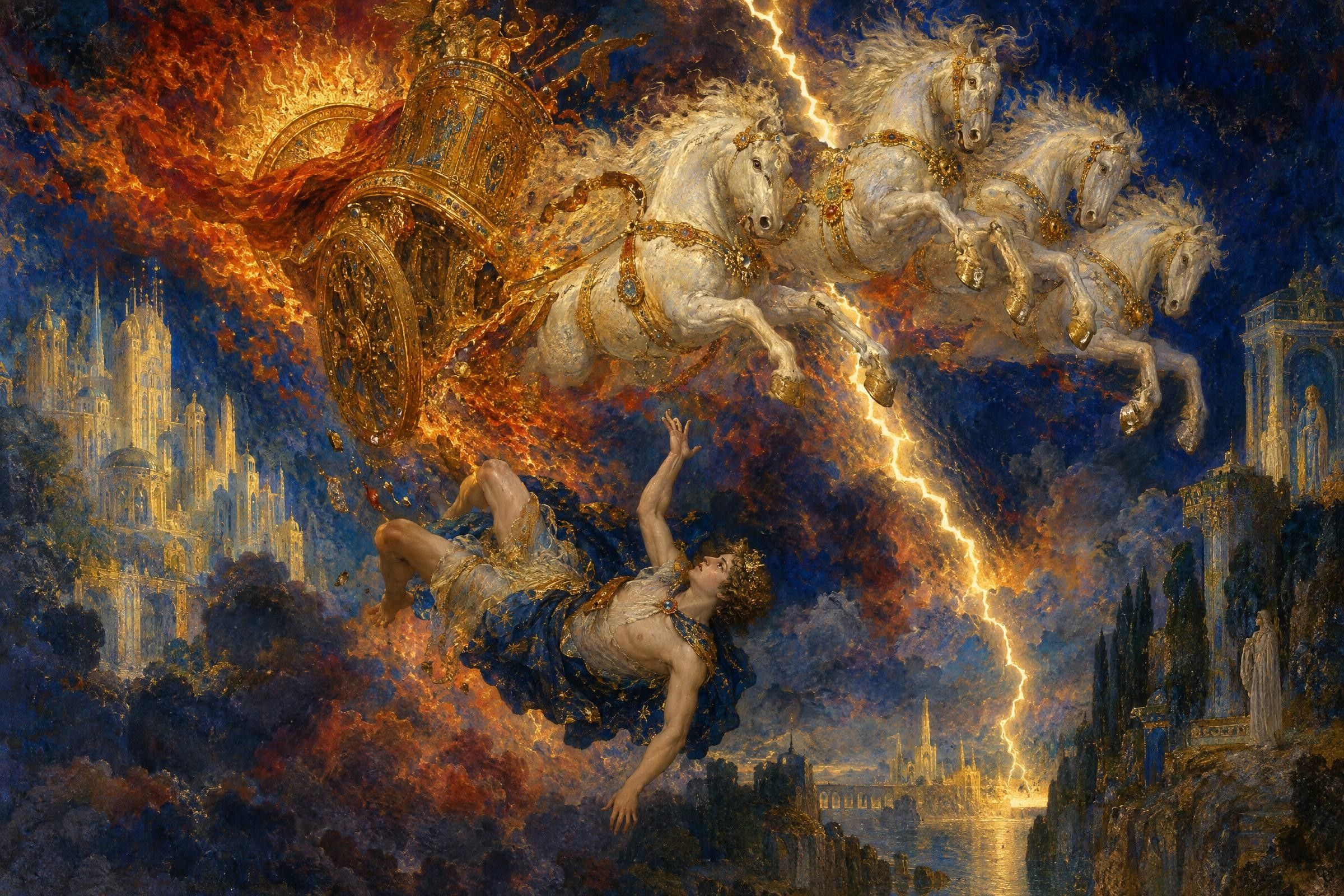
Phaethon was the son of the Sun, and no one believed him. His mother swore it was true, but the boys he grew up with laughed, and at last he went east to the edge of the world to hear it from his father’s own mouth.
The Sun received him in a palace of gold and ivory and set aside the rays around his head so the boy could come near. You are my son, he said, and to prove it I will give you anything you ask. He swore it by the river Styx.
Phaethon asked for the chariot. One day — only one — to drive the horses of the Sun across the sky.
His father knew at once what he had promised. He begged the boy to choose anything else. Not even Zeus drives these horses, he said. The road climbs so steeply at dawn that they can barely make it fresh, and at noon the height turns even my head. You are asking for a mortal’s share of a god’s work. But the oath was sworn, and the boy would not be moved.
So at dawn the gates were opened, and Phaethon stood in the chariot with the reins in his hands, and for a moment he was glorious.
The horses knew before he did. The chariot rode too light; the hands on the reins were not their master’s. They left the worn track and ran where they wished — up until the stars scattered from them, then down until the fields caught fire. Rivers boiled in their beds. Forests burned on the mountains. Phaethon forgot the horses’ names, and could no longer tell which rein was which. He had been given the whole of the Sun’s power, and not one day of the Sun’s practice.
At last the Earth herself lifted her scorched face and cried out to Zeus, and Zeus did the only thing that would stop the ruin. He threw a single bolt. The boy fell from the chariot like a star falling, trailing fire, into a river far from home. His sisters wept for him on the bank until they became poplar trees, and their tears hardened into amber.
He had not been wrong to be the Sun’s son. He had been wrong to think that being his son made him able to drive.
The trading concept
Hubris after a win. A strike from the sky feels like proof — proof of the method, of the judgment, of the trader. And the natural next wish is for more: larger positions, more of the account, the whole chariot instead of the seat beside it.
But a win is evidence of exposure, not of mastery. The skill that managed a small allotment has not been tested at ten times the size, and the market, like the Sun’s horses, can feel the difference in the hands on the reins before the driver can. Scaling up too fast after success turns the same volatility that paid you into a force you cannot steer, and the damage lands not only on the position but on the ground beneath it — the core that was never meant to be risked.
The discipline is to let size grow at the pace of demonstrated skill, by rules fixed before the win arrived, so that no single triumph can hand anyone the reins of the Sun.
Further reading
- Ovid, Metamorphoses, end of Book 1 and Book 2 — the fullest telling of Phaethon’s ride and fall.
- Gustave Moreau, Phaethon (1878), watercolour, Musée du Louvre (Département des Arts graphiques), Paris.