Achilles' Choice
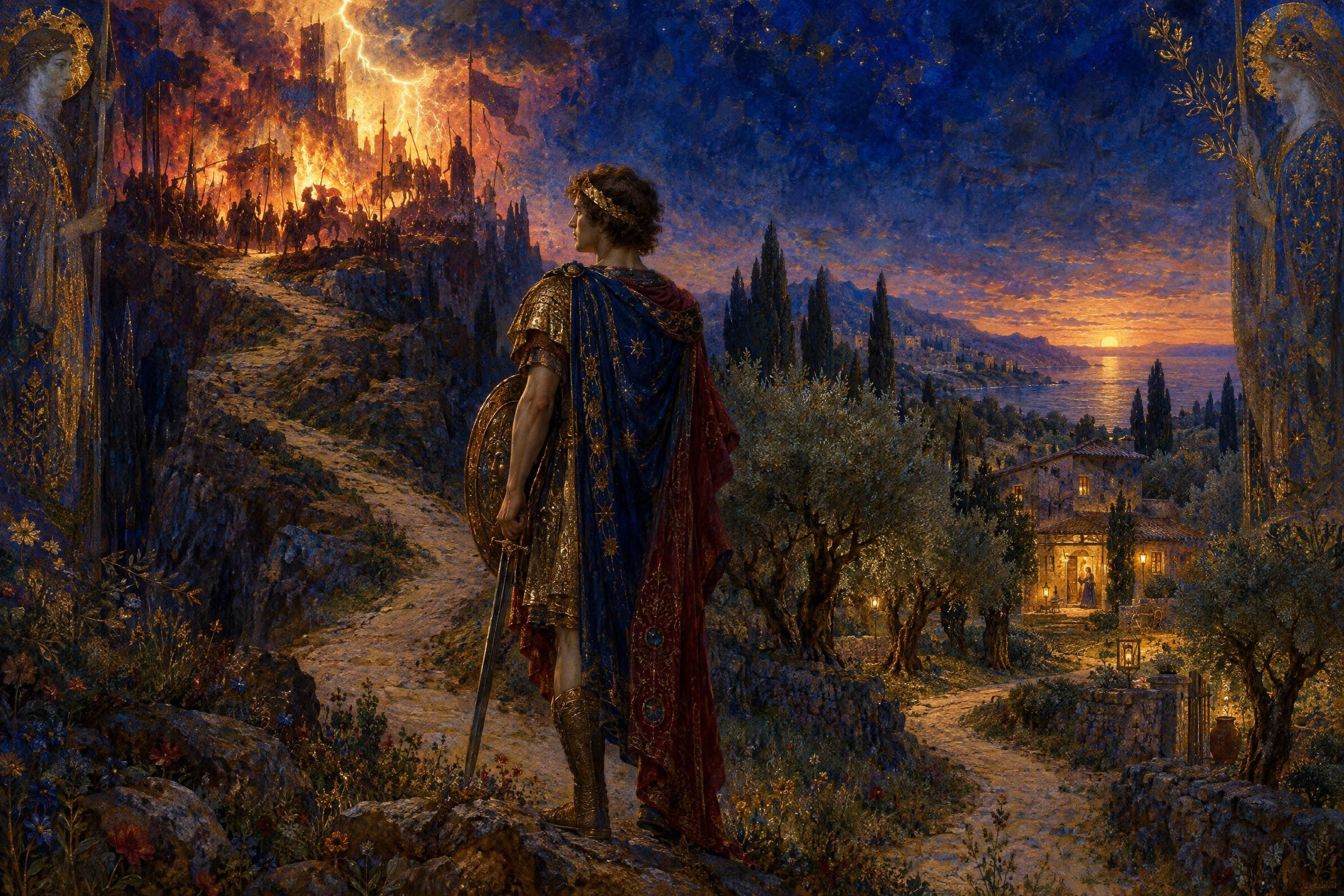
Achilles was the son of a mortal king and a sea-goddess, and he was raised on the slopes of Mount Pelion by the wise centaur Chiron, who taught him to ride and hunt and heal. He grew into the swiftest and strongest of the Greeks. And his mother, Thetis, who could see further than mortals, told him something about himself that no one else knew.
He had two fates, she said, and he would have to choose between them.
If he stayed and fought at Troy, he would never come home. He would die young, under the walls of the city. But his glory — kleos, the fame that is sung — would never die. As long as there were people to tell stories, they would tell his.
If he went home instead, to his father’s house in Phthia, he would live a long life. He would marry, and see his fields and olive groves come to harvest year after year, and grow old in peace among his own people. But his glory would be gone. No one would sing of him. When he died, he would be forgotten, like every other quiet man who ever lived well.
For a long time at Troy, sulking in his tent, Achilles said he would take the second fate. He told the envoys who came to plead with him that no amount of treasure was worth a man’s life — that cattle and sheep can be raided and gold can be won, but a life, once it has passed the barrier of the teeth, does not come back. He said he would sail home at dawn.
He did not. In the end he chose the short life and the undying song, and the poets kept their side of the bargain. Nearly three thousand years later, his name is still spoken.
It is the oldest version of a question every life asks. Do you stake everything on the brilliant, dangerous thing that may make you immortal, or do you take the slow, safe road that ends in a full granary and a quiet grave? Achilles had to choose, because he had only one life to give.
Capital is not a life. It can be divided.
The trading concept
The barbell as a life decision. Most people assume the choice Achilles faced is the choice every investor faces: the glorious, volatile path or the dull, durable one. Aim for the extraordinary return and accept the risk of ruin, or accept a modest return and sleep at night.
Project Ouranos refuses the choice. It gives a small part of its capital to the hero’s fate — exposed to the sky, to the rare strike, to the kind of outcome that is remembered — and sets the rest on the farmer’s road, among the olive trees, compounding slowly and surviving everything. This is Taleb’s barbell: extreme safety on one side, extreme convexity on the other, and very little in the uncertain middle, where risk is taken without the chance of glory.
The hero’s portion may be lost in full, and the farm will not notice. The farmer’s portion may never be sung about, and the hero will not need it to be. Together they are something Achilles could never be: glorious and old.
Its shadow → Phaethon’s Chariot: the hero’s portion, allowed to grow until it drives the whole estate, burns the farm it was meant to protect.
Further reading
- Homer, Iliad, Book 9 — Achilles tells the envoys of his two fates, lines 410–416.
- Homer, Iliad, Book 1 — the quarrel that sends Achilles to his tent.
- Nassim Nicholas Taleb, Antifragile — the barbell.
- Gregory Nagy, The Best of the Achaeans — kleos and the hero’s choice.