The Blind God of Wealth
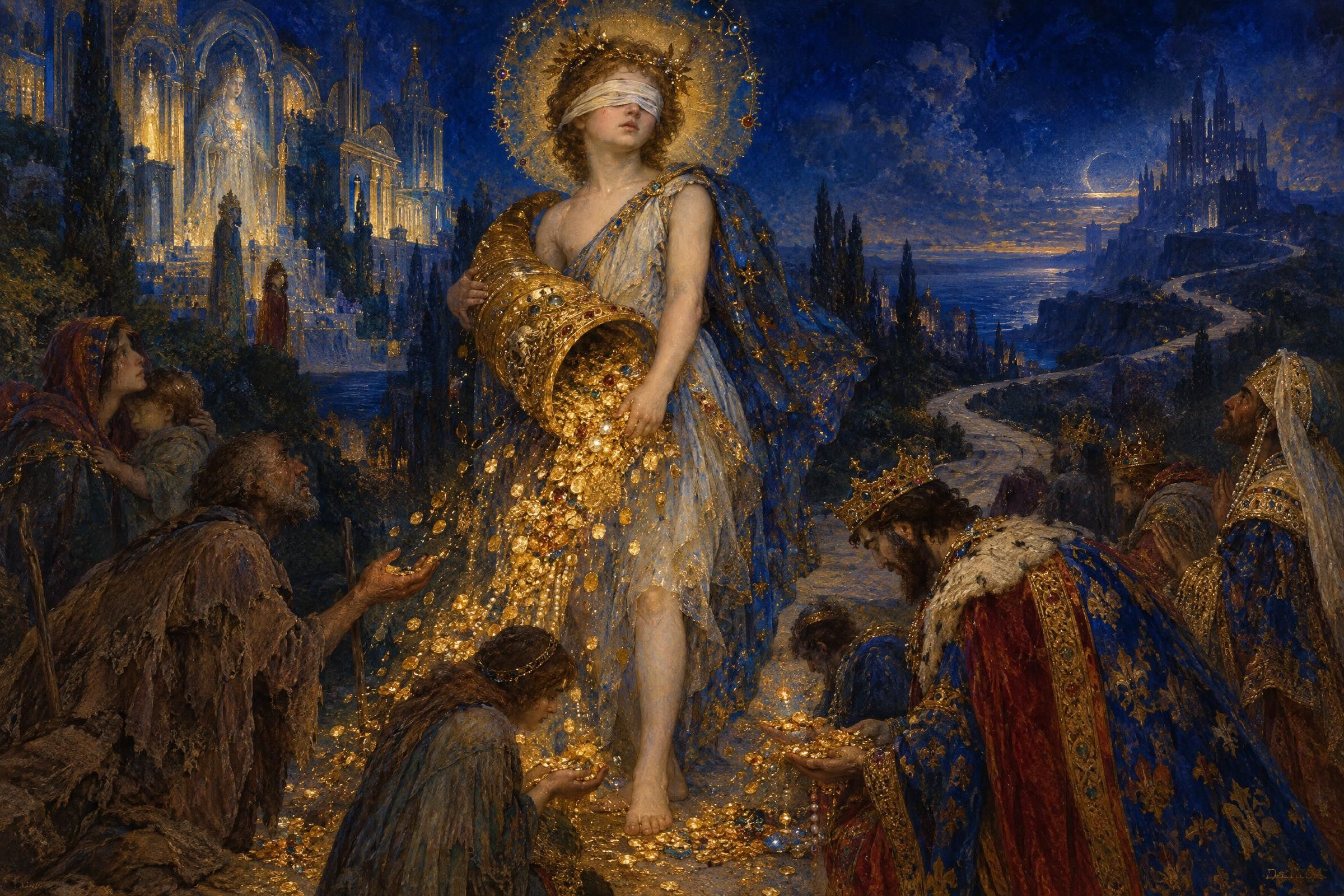
Ploutos, the god of wealth, was born in a field. Demeter lay with the hero Iasion in a fallow furrow that had been ploughed three times over, and the child of that union was Wealth itself — a god who wandered the earth and made rich whoever he came to.
When he was young, Ploutos made a vow: he would go only to the just, the wise and the decent, and pass the wicked by. Zeus heard it, and Zeus struck him blind. From then on Ploutos could not tell one door from another. He came to the honest and the crooked alike, and left a good man’s house as suddenly as he had entered it. No one could court him. No one could earn him. He simply arrived, and simply went.
In Athens, the comic poet tells us, an honest farmer named Chremylos grew tired of this. He had worked hard all his life and stayed poor, while scoundrels around him prospered. So he went to Delphi to ask the god whether his son should give up honesty altogether. The oracle told him to follow the first man he met on leaving the temple — and the first man he met was a ragged, blind old beggar, who turned out to be Ploutos himself.
Chremylos had a better idea than giving up honesty. He took the god to the temple of Asclepius and had his eyes healed. Now Ploutos could see. Now he went only to the good. The honest grew rich overnight, the wicked were left with nothing, and the world seemed set right at last.
Then the smoke stopped rising from the altars.
Why would anyone sacrifice now? If wealth could see, and came to the deserving as surely as sunrise, there was no reason to pray for it and no reason to offer anything to the sky. The gods began to go hungry. Hermes himself came down to Chremylos’s door and begged for a job. The priest of Zeus deserted his temple, because no one brought him anything any more.
The comedy ends in laughter, with the gods on the doorstep and Wealth installed in the city treasury. But the joke has an edge. The world the offerings belonged to — the world of hope, and favour, and gifts laid on the altar with no promise of return — existed only because Wealth could not see.
The trading concept
Why convexity is worth paying for. If outcomes could be predicted, no one would ever pay a premium. No one would buy the chance of a strike, because everyone would know where it would land. The market for convexity exists because wealth is blind.
This is the philosophy’s quiet foundation. It does not claim to know where Ploutos is going next. It assumes that he does not know either — that large gains come to whoever happens to be standing in the right place, not to whoever deserved them or forecast them. Under that assumption, the only sound strategy is to be in many places at modest cost, rather than in one place at great cost, certain you have seen what the god cannot.
Its shadow → Narcissus at the Pool: the trader who believes his model has given Wealth its sight has only fallen in love with his own reflection.
Further reading
- Aristophanes, Wealth (Ploutos), 388 BC — Chremylos, the blind god, and the starving gods.
- Hesiod, Theogony — Ploutos born to Demeter and Iasion in a thrice-ploughed field.
- Kephisodotos, Eirene and Ploutos, c. 370s BC — Peace holding the infant Wealth; a Roman copy is in the Glyptothek, Munich.