The Year Nothing Grew
The shadow ofThe Gift of Grain, The Seasons of Persephone and The Keeper of the Hearth
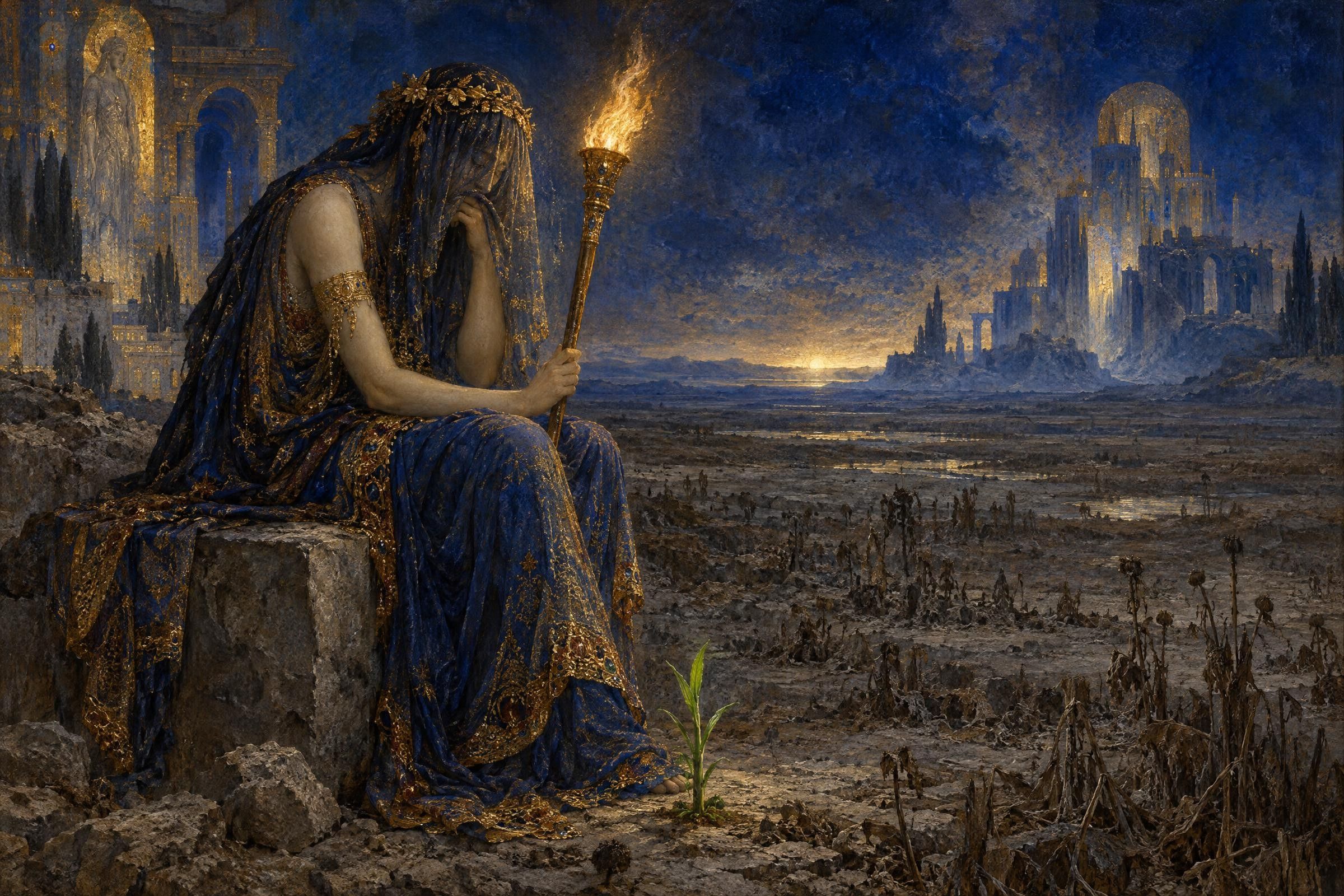
Persephone was gathering flowers in a meadow when the earth opened beneath her and she was carried down into the dark. Her mother heard one cry, and then nothing.
For nine days Demeter searched the world with a torch in each hand. She did not eat, she did not bathe, she did not rest. When at last the Sun, who sees everything, told her what had happened — that Zeus had allowed it, and that her daughter would not be given back — her grief turned into something harder.
She left Olympus. She put on the shape of an old woman and sat by a well at Eleusis, among mortals, and would not go home. And she withdrew her gift.
That year the seed lay in the ground and did not rise. The oxen dragged the plough through the fields for nothing; the barley was scattered and the earth kept it. Nothing sprouted, nothing ripened, nothing came to the threshing floor. The people began to starve, and the smoke of sacrifice stopped rising to the gods, because there was nothing left to burn.
Zeus sent Iris to call her back. She would not come. He sent the gods one after another, each with gifts and honours. She refused them all. No command could make the grain grow, and she would not let the earth bear until she saw her daughter again.
So the storm could not be broken. It had to be settled.
Hermes went down into the dark and brought Persephone up into the light, and mother and daughter held each other for a whole day. But the maiden had eaten a pomegranate seed below, and so terms were struck: for a third of every year she would return to the dark, and for the rest she would stay with her mother.
Then Demeter let the fields go. The barley rose, the whole wide earth grew heavy with leaves and flowers, and the people ate again. The long hunger had ended not because anyone had defeated the goddess, but because the world had waited, and kept what it could, until an agreement was made.
The trading concept
Drawdowns and bear markets. There are seasons when the core yields nothing. Prices fall and keep falling; the holdings that were supposed to be the safe ground go grey together; liquidity dries up and no one is buying what you would like to sell.
Nothing in the philosophy prevents that year. The earth is diversified so that no single storm ruins it, but the grief of Demeter is not a single storm — it is the whole ground withholding at once. The question is not how to force the harvest. It cannot be forced. Every attempt to command the grain in a drought only spends seed.
The question is how to still be standing when the terms are struck. That is what the reserve is for, and why it is kept in good years: the household that kept its fire survives the winter it could not prevent. Recovery comes by endurance and by settlement — the slow return of buyers, the market finding a price the world can agree on — not by fighting the goddess.
Further reading
- Homeric Hymn to Demeter (Hymn 2) — the abduction, Demeter’s search and grief at Eleusis, the barren year, and the settlement.
- C. G. Jung and Karl Kerényi, Essays on a Science of Mythology — the essays on the Kore and Demeter.
- Erich Neumann, The Great Mother — the earth that both nourishes and withholds.