Typhon Rises
The shadow ofSky and Earth and Leave the Greater Part Ashore
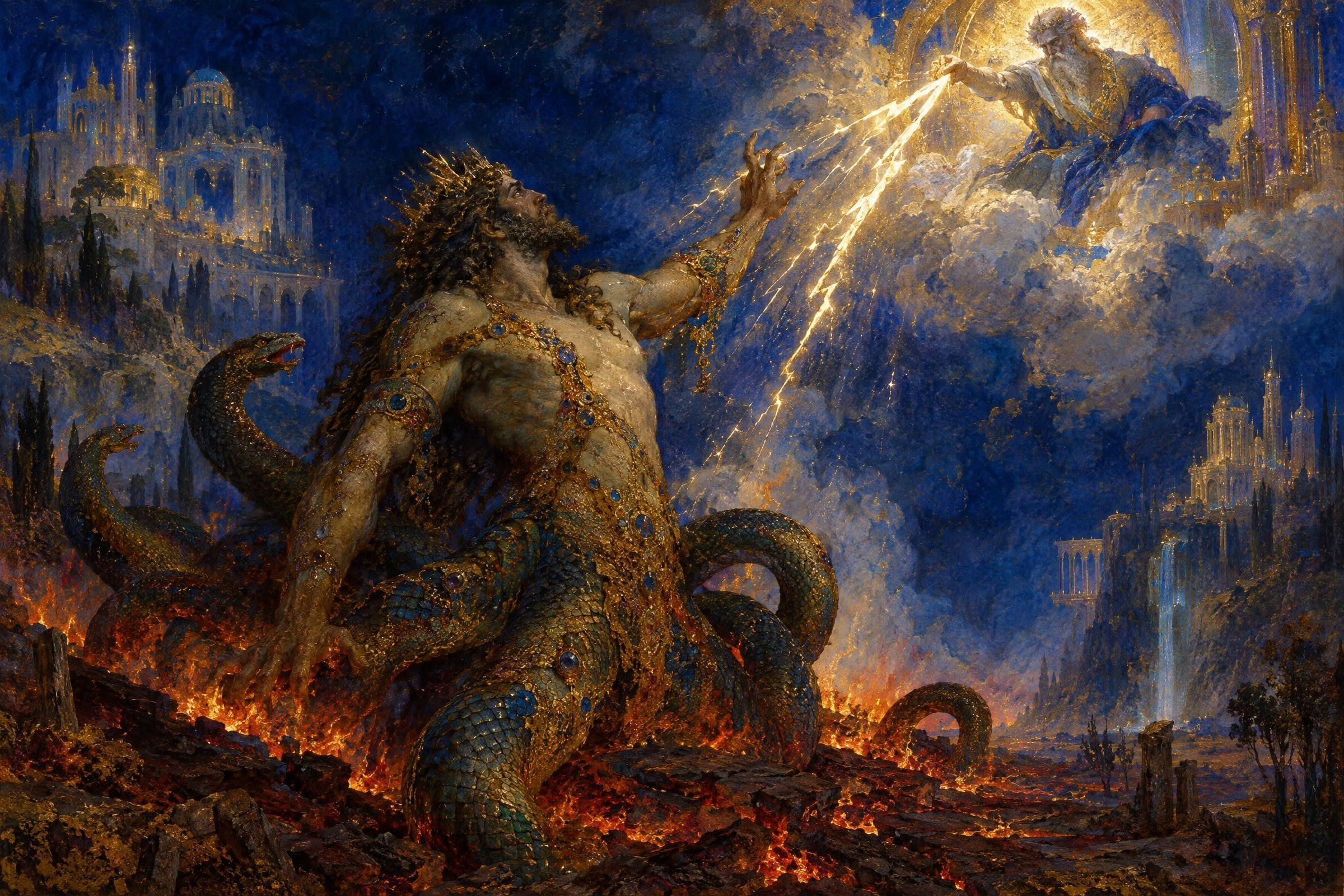
When the war of the gods was over and the Titans had been driven from the sky, the new order seemed secure. Zeus held the heavens. The earth was quiet under the fields. Everything that could threaten the peace had been fought, and beaten, and bound.
But Earth had not finished bearing children. Out of her own depths, from the same ground that fed the grain and held the roots of every tree, she brought forth the last and greatest of her sons. His name was Typhon.
He rose from the earth so huge that his head brushed the stars. From his shoulders grew a hundred serpents’ heads, their dark tongues flickering, fire blazing from their eyes. And each head had its own voice. One spoke in a language the gods understood; one bellowed like a bull; one roared like a lion; one barked like a pack of hounds; one hissed so that the mountains echoed. A hundred heads, a hundred voices, and all of them one body, moving together toward the sky.
He came from the ground that everyone had trusted. That was what made him terrible. No one had watched the earth for danger; the earth was where danger was supposed to end.
Had Zeus been slow that day, Typhon would have ruled both gods and men. But Zeus did not reason with him, or bargain, or try to outwait him. He stood up in the heavens and loosed his thunder. The bolts the Cyclopes had forged for him — thunder, flash and brightness — fell one after another on the monster, on every one of his hundred heads at once. The sea boiled. The ground shook down to its roots. The earth itself melted like tin in a smith’s furnace, and Typhon was burned and broken and thrown down.
Some say he was cast back into the deep beneath the earth that bore him. Others say Zeus pinned him under a mountain in Sicily, and that the fire still leaking from Etna is his breath, and that when the ground trembles there, it is Typhon turning over in his sleep.
Either way, the earth could not defeat what the earth had made. Only the sky could.
The trading concept
Tail risk from the safe core. The large, diversified core of a barbell is built to be the quiet ground — many holdings, many sources of return, each meant to move on its own. In ordinary times it does. But in a crisis, the hundred heads turn out to share one body: correlations converge, assets that never moved together fall together, and the diversification that looked like safety becomes a single monster rising out of the fields.
This is the reason the philosophy holds any lightning at all. The small convex allotment — long, out-of-the-money options, the positions that pay when the world breaks — does not merely offer a chance at glory. It is the one part of the portfolio built to strike back when the earth itself turns on you. The core cannot defend against its own monster. The sky can.
A barbell is not two separate bets. It is a garden and the thunder that guards it.
Further reading
- Hesiod, Theogony — the birth of Typhoeus from Gaia and his defeat by Zeus’s thunderbolts.
- Pindar, Pythian 1 — Typhon pinned beneath Etna.
- Apollodorus, Library, 1.6.3 — a fuller, later version of the battle.
- Nassim Nicholas Taleb, Antifragile — the barbell.