Leave the Greater Part Ashore
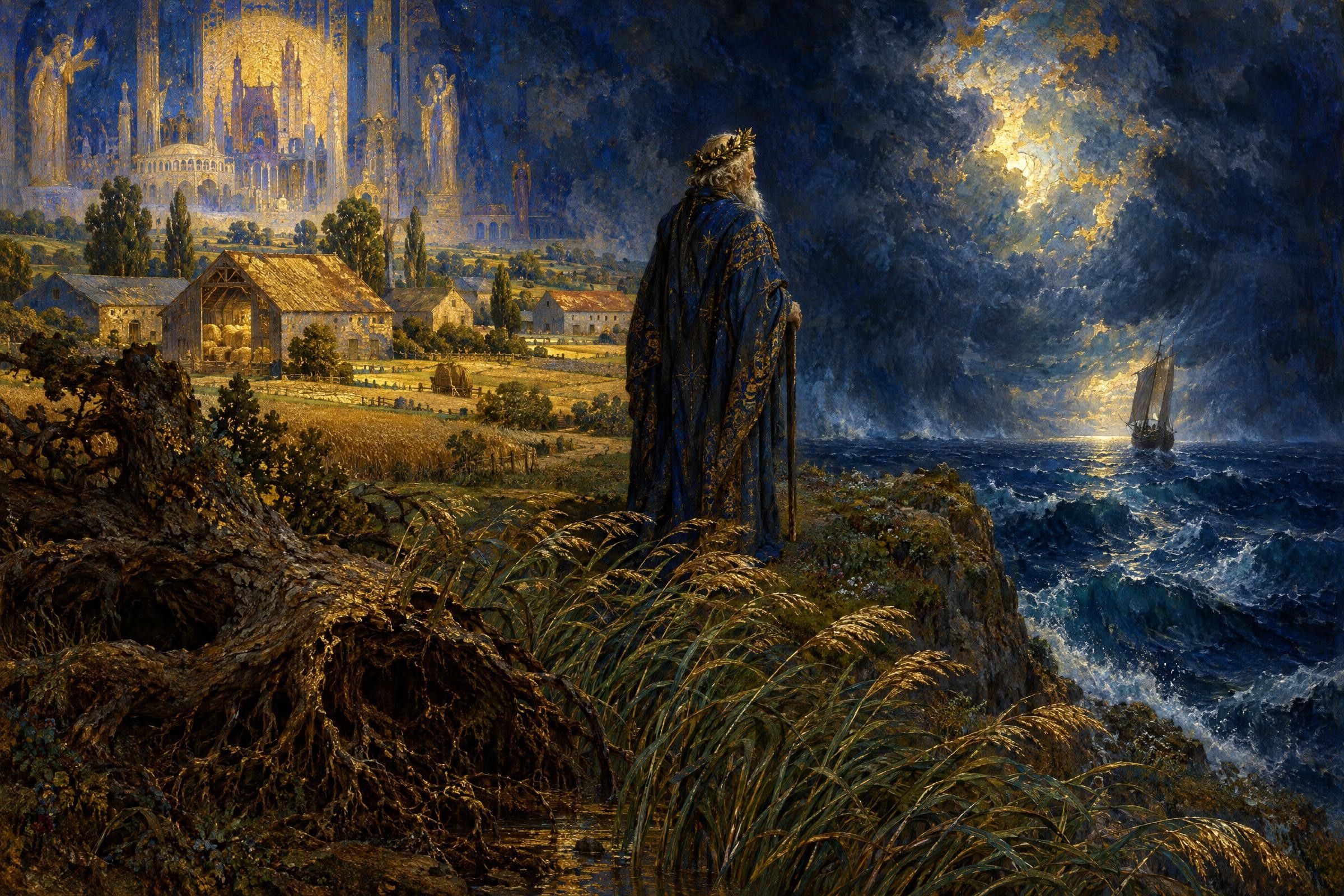
Hesiod’s father was a merchant who sailed. He worked the sea out of Kyme, on the coast of Asia, trying for the fortune that ships can bring, and he did not find it. He ran from poverty across the water and settled at last in Ascra, under Mount Helicon — a wretched village, his son said, bad in winter, hard in summer, good at no time at all. There the family farmed.
So the poet of the farm knew the sea from the inside, and did not love it. He had crossed open water only once in his life, a short hop from Aulis to Euboea, to sing at the funeral games of a king, where he won a tripod and gave it to the Muses. That was all the sailing he wanted.
But he did not tell his brother never to sail. He was a practical man. There is a season for it, he said — the fifty days after the summer turning, when the winds are steady and the sea is kind — and a man can send out a cargo then, and may come home with profit. Only do it the right way:
Do not put all your livelihood in hollow ships. Leave the greater part behind, and ship the lesser.
For it is a terrible thing to meet disaster among the waves, and a terrible thing to load a wagon past what its axle can bear and see the load spoiled. Keep measure, he said. Proportion is best in all things.
There is an older story still, told among the fables. An oak stood by a river, tall and proud of its strength, and when the great wind came it stood against the wind, and the wind tore it out by the roots and threw it into the stream. Floating down, it passed a bed of reeds, still standing, whole and green. How is it, the oak asked, that you, so thin and weak, have survived what broke me? And the reeds said: You fought the storm. We bent, and let it pass.
The trading concept
The barbell’s oldest statement. Two and a half thousand years before anyone called it a barbell, a farmer-poet put it plainly: send the lesser part to sea, where the fortunes and the shipwrecks are, and keep the greater part safe on land. The small allotment is exposed to the sky’s unpredictable weather, with a loss that is bounded by what was loaded aboard. The large core stays in the barns. Neither half is asked to do the other’s job.
The oak and the reeds add the second half of the lesson: resilience by structure, not by defence. The oak survives only if it is strong enough to beat the storm, and some storm always is stronger. The reeds survive because of how they are made. A portfolio is kept safe the same way — not by predicting the wind, or by standing against it, but by being arranged so that no wind can take everything at once.
Its shadow → Typhon Rises: the day the danger comes up not from the sea but from the safe ground itself.
Further reading
- Hesiod, Works and Days — the passage on seafaring: his father’s voyage, his own crossing to Euboea, and the warning against hollow ships.
- Aesop, “The Oak and the Reeds” (Perry 70).
- Nassim Nicholas Taleb, Antifragile — the barbell.