The Return to the Plough
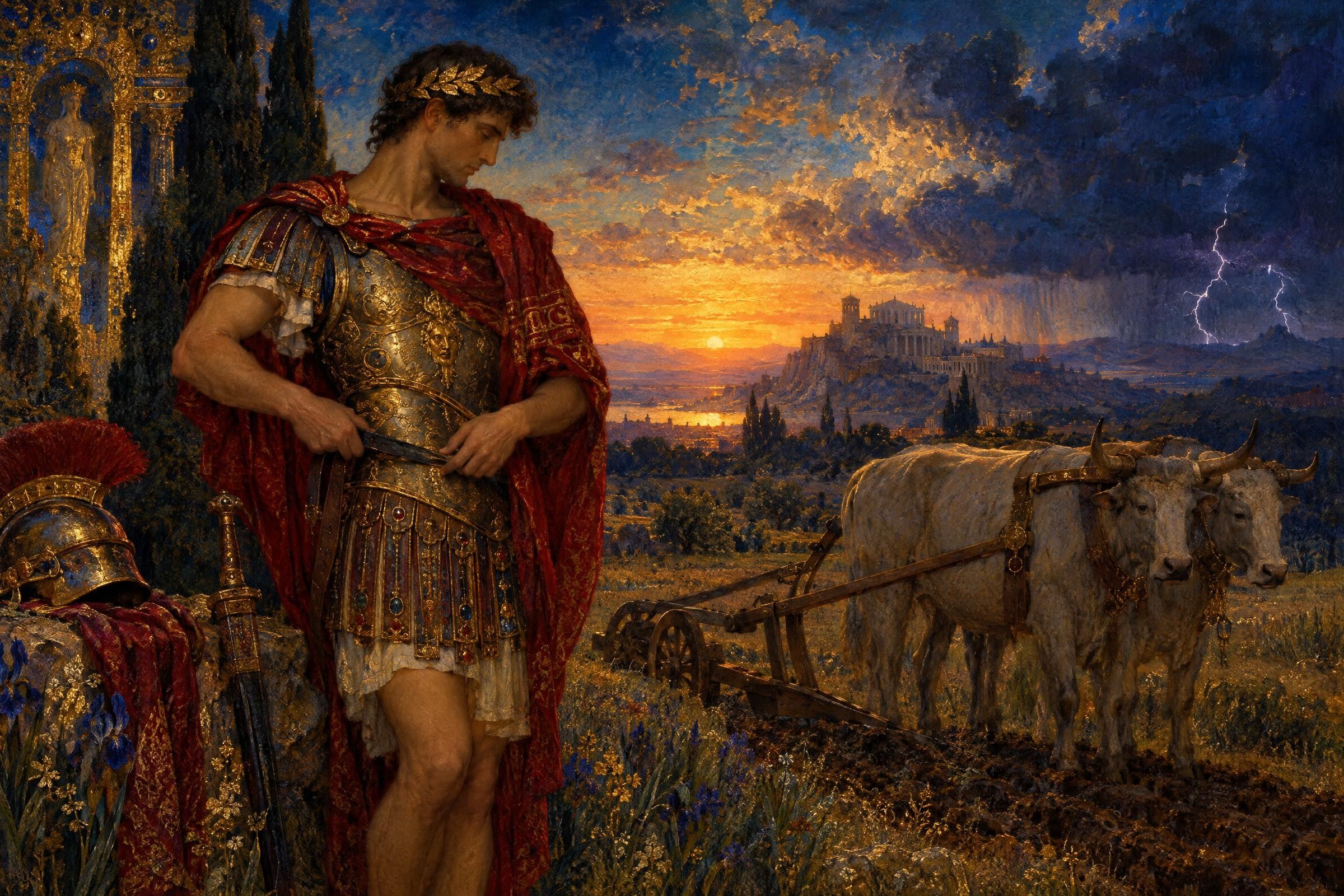
In the early days of the Republic, a Roman army marched into the hills against the Aequi and walked into a trap. The enemy closed the valley behind it, and a consul and his legions sat surrounded on the slopes of Mount Algidus, waiting to starve. A few riders slipped through the lines and brought the news to Rome.
The Senate did what Rome did only in its gravest danger: it resolved to name a dictator, one man with absolute power for as long as the crisis lasted. And it chose Lucius Quinctius Cincinnatus.
The envoys did not find him in the city. They found him across the Tiber, on his small farm of four iugera, bent over the soil, working his own field. They greeted him and asked him to put on his toga to hear the Senate’s command. He wondered aloud if all was well, and called to his wife, Racilia, to bring it from the house. He wiped the dust and sweat from his face, put on the toga, and the envoys hailed him as dictator.
He went to Rome, called up every man of fighting age, and marched through the night. At dawn his army was around the Aequi, as the Aequi were around the consul. By the end of the day they had surrendered. He sent them under the yoke and took the spoils for the men who had won them.
Rome gave him a triumph. He rode through the city in the chariot, the captured enemy leaders walking before him, his soldiers singing behind. In later centuries Romans would say that beside every general in his triumph a slave stood holding the golden crown over his head, and whispered to him as the crowds roared: Look behind you. Remember that you are a man.
Cincinnatus needed no one to tell him. He had been given absolute power for six months. He laid it down on the sixteenth day, and went home to his plough.
The trading concept
Harvesting the strike. A convex trade that pays off is an emergency of the good kind: a short, sudden moment when a small commitment is suddenly worth a great deal. What happens next matters as much as what happened before. The winnings are not left out in the storm. They are brought home and ploughed back into the core, where they can grow slowly with everything else — and a portion is set aside so that new offerings can be made to the sky.
Just as important is what the victor does not do. The dictatorship is laid down. A strike does not make the one who caught it a different kind of trader, and it does not license larger bets, a new set of rules, or a belief that the sky will now answer on demand. The triumph is real, and it is brief. Then the field is waiting.
Its shadow → Pandora’s Jar: every windfall arrives with a sealed jar, and not everyone who opens it goes home to the plough.
Further reading
- Livy, History of Rome, Book 3, 26–29 — Cincinnatus called from the plough, the relief of the consul’s army, and the sixteen-day dictatorship.
- Tertullian, Apology 33.4; Pliny, Natural History 33.11; Juvenal, Satires 10.41–42; Zonaras 7.21 — the triumph’s reminder of mortality, a custom attested from later Roman writers.