Pandora's Jar
The shadow ofBorn of the Sky and The Return to the Plough
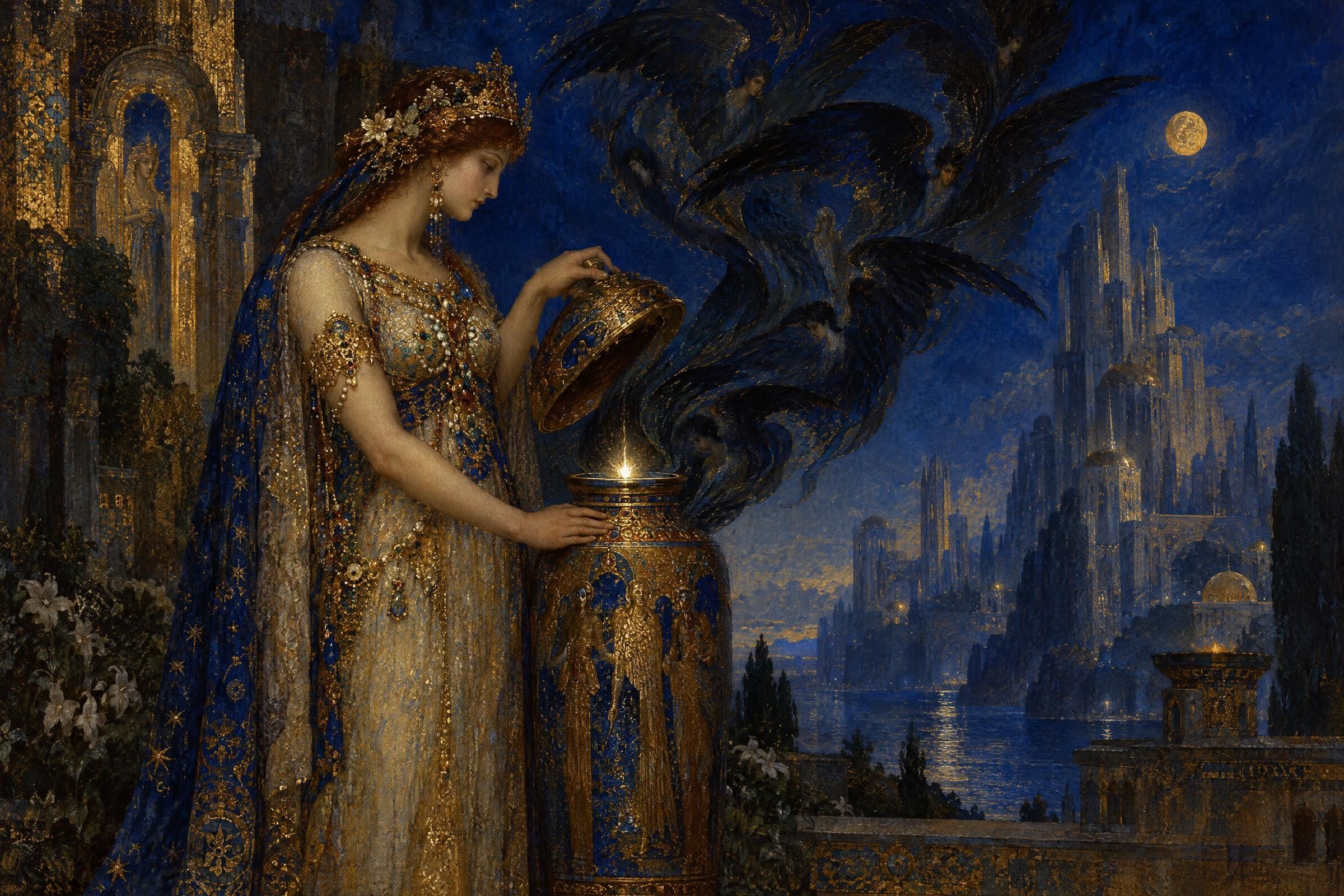
When Zeus saw the glow of fire in the houses of men, and knew it had been stolen, he laughed. You are pleased with your theft, he said to Prometheus. So I will give them something in return, a gift they will all delight in, and embrace, and it will be their ruin.
He ordered Hephaestus to mix earth with water and shape from it a woman, lovely as the goddesses. Athena taught her weaving and dressed her in silver. The Seasons crowned her with spring flowers. Aphrodite poured grace over her head, and longing. The Graces and Persuasion hung gold at her throat. And Hermes, last of all, put into her a quick tongue and a thievish mind. They named her Pandora, all-gifts, because every god had given her something.
Prometheus had warned his brother never to accept a gift from Zeus. But his brother was Epimetheus, whose name means afterthought, and when Hermes led the beautiful woman to his door, he took her in. Only later did he understand.
She had brought with her a great jar, tall and sealed, of the kind in which a household stores its grain and oil. No one told her what was in it. One day she lifted the lid.
Out of it flew everything that had never been in the world before: sickness that comes silently in the night, toil that never ends, sorrow, and ten thousand other troubles. Before, men had lived free of all of these. Now they filled the earth and the sea, and they have never been gathered back.
Pandora pressed the lid down again, at Zeus’s will — just in time, or just too late. One thing had not escaped. It lay under the rim of the jar, and it stayed there.
Its name was Hope.
The poets have argued ever since about why it was left behind. Some say it was the one kindness in the jar, kept for men to hold when everything else had gone wrong. Others ask why a jar of evils would contain a blessing at all, and whether hope is not the most patient of the troubles — the one that stays with you.
The trading concept
Every windfall brings its consequences. Fire taken from the sky does not arrive alone. A large gain carries its own jar: overconfidence in a method that may simply have been lucky, a lifestyle that expands to match the new number, the bill from the tax collector, the belief that the next strike is owed. None of these appears on the day of the win. They come out quietly afterwards and are very hard to put back.
And then there is Hope, which the philosophy treats as the most ambiguous thing in the jar. Hope is what lets a trader keep paying a small, steady premium through the long empty seasons — a necessary virtue. But hope is also what keeps a losing trade open past its rule, waiting for the market to come back to where it was. The first kind is written into the plan in advance. The second kind is what happens when the plan is set aside.
Epimetheus’s mistake is the other lesson: he accepted the gift before he thought about it. Forethought first; the jar is opened by afterthought.
Further reading
- Hesiod, Works and Days — the making of Pandora, the jar, and Hope left under its rim.
- Hesiod, Theogony — the first woman sent in return for the fire.
- Dora and Erwin Panofsky, Pandora’s Box: The Changing Aspects of a Mythical Symbol (1956) — how the jar became a “box”.