The Stone in Swaddling Clothes
The shadow ofThe Farmer King and The Bronze Guardian
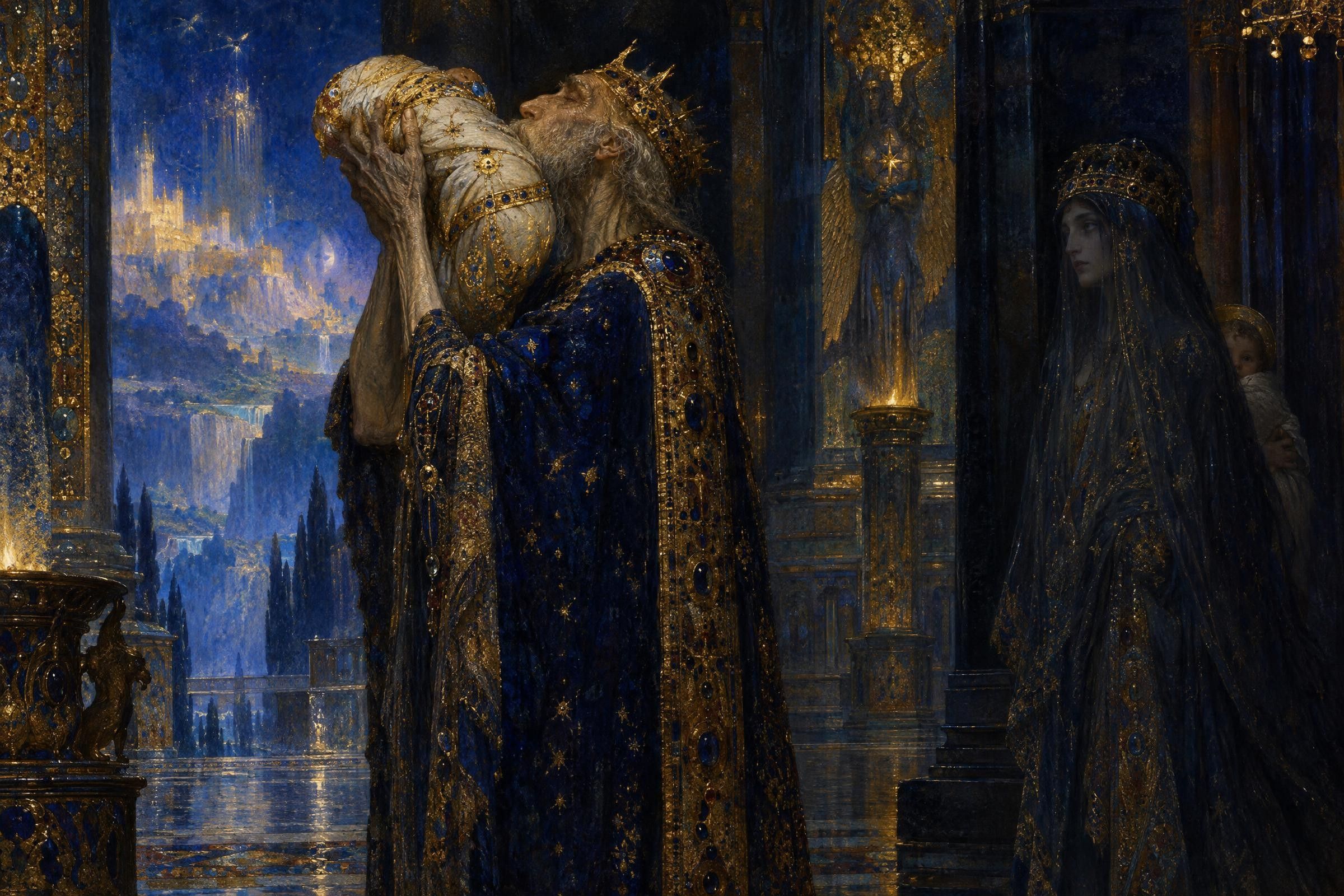
Kronos had taken the sky from his father with a sickle, and he meant to keep it. Earth and Sky had told him the one thing he feared: that he too would be overthrown, by a child of his own.
So he made a rule, and he kept it without exception. Each time his wife Rhea bore him a child, he took it from her arms and swallowed it whole. Five children went down into the dark of their father, and the throne stayed safe. The rule was working. Nothing had ever gone wrong while he followed it.
Rhea grieved, and then she planned. When her sixth child was about to be born, she went to her parents, Earth and Sky, and asked them how to save him. They sent her by night to Crete, and there, in a cave on a wooded mountain, she bore a son and hid him. His name was Zeus.
Then she took a stone — a plain grey stone from the hillside — and wrapped it in swaddling clothes, and carried it home to her husband.
Kronos took it from her as he had taken all the others. He did not unwrap it. He did not weigh it in his hands, or look at the face, or notice that it did not cry. It had the shape of what he expected, and it came to him through the channel his children had always come through, and he had done this five times before. He swallowed it and was satisfied.
The rule had been followed perfectly. That was the trouble. It was being followed on a false input, and nothing in the rule asked whether the input was true.
Years passed while the hidden child grew strong on the mountain. When he came at last, he forced his father to bring up everything he had swallowed. The stone came first, and then the children, one after another, grown and angry. The war that followed ended the reign of Kronos forever.
Zeus set the stone up at Delphi, at the navel of the world, as a sign for mortals: a plain grey stone, kept and honoured, so that no one would forget what it had once been mistaken for.
The trading concept
Discipline turned rigid devours growth. Rules are the Saturnian virtue of the philosophy — fixed in advance, followed without mood. But a rule that is kept only to protect what already exists, and never examined, begins to eat the new ideas that would have replaced it. Kronos did not fall for breaking his rule. He fell for keeping it past the point of sense.
For an automated system, the swallowed stone has a sharper meaning: bad data. A price feed that has quietly stopped updating, a stale quote, a corrupted bar, a split nobody adjusted for — each arrives looking exactly like the real thing, through the same channel as every real input before it. A system that acts on it without inspecting it will execute its rules flawlessly on something that is not there.
The defence is to check the swaddling before swallowing: validate every input for freshness and sanity before acting on it, and keep a record of every false input caught, so the stone is remembered for what it was mistaken for.
Further reading
- Hesiod, Theogony — Kronos swallowing his children, Rhea’s stone, and the stone set up at Delphi.
- Pausanias, Description of Greece, Book 10 — the stone still honoured at Delphi in his day.
- Raymond Klibansky, Erwin Panofsky and Fritz Saxl, Saturn and Melancholy (1964) — Saturn’s dark side.
- Francisco Goya, Saturn Devouring His Son (c. 1819–1823), Museo del Prado, Madrid.