The Bronze Guardian
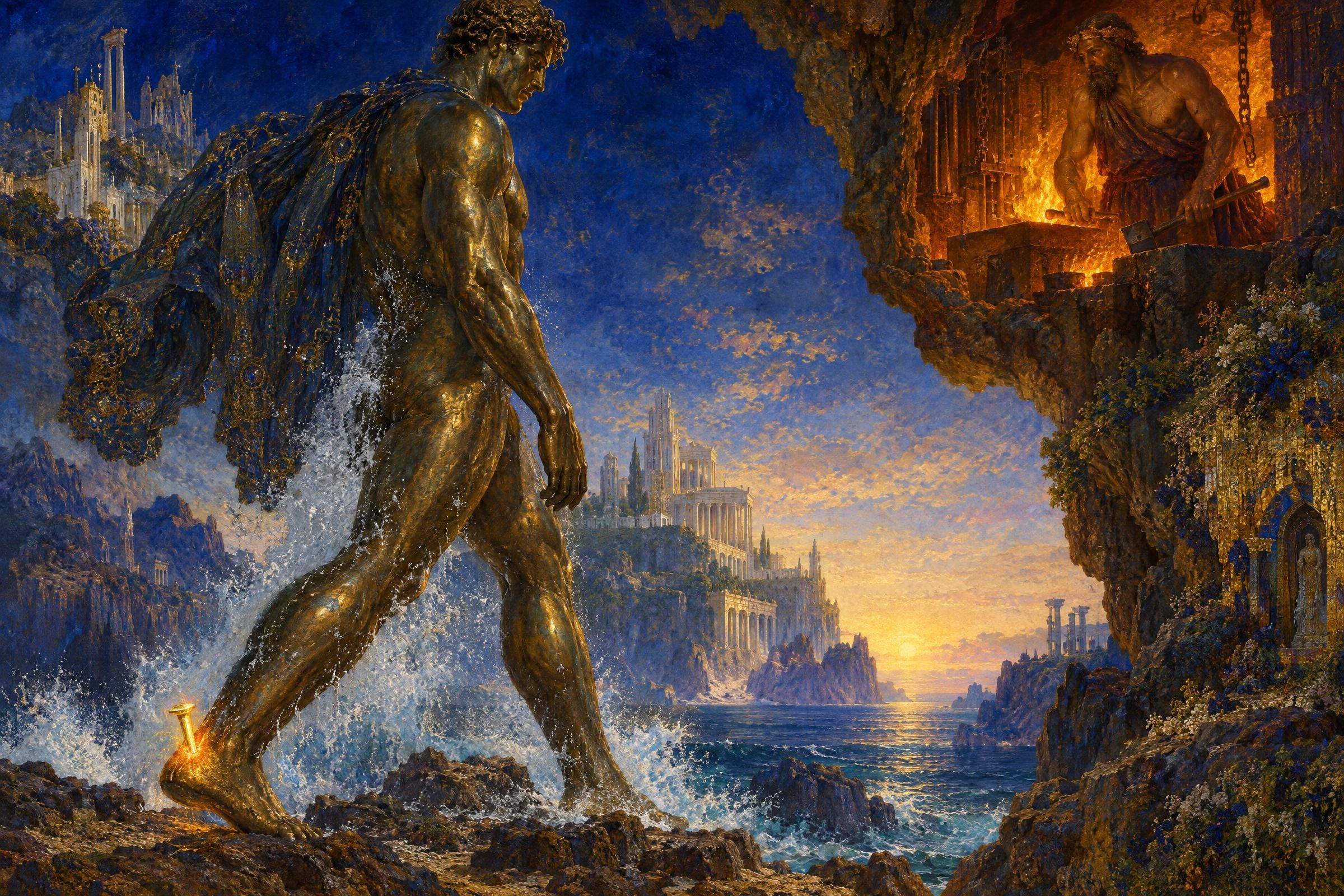
Hephaestus, the lame smith of the gods, could not walk far without help, so he made his help. From gold he forged serving-maidens who moved of themselves, who had minds and voices and strength, and who walked at his side to hold him up. He built tripods on golden wheels that rolled of their own accord into the assembly of the gods and rolled home again. Nothing in his workshop waited for a hand to push it.
His greatest work was Talos. Some say Talos was the last of the race of bronze; others that Hephaestus made him and gave him to Minos, king of Crete. All agree on what he did. Three times every day he strode the whole coast of the island, and no ship came near that he did not see. He did not sleep. He did not tire. He did not ask what the king wanted this morning, or whether the day felt dangerous. He walked his circuit because that was what he was made to do, and when strangers came, he broke rocks from the cliffs and hurled them at their ships.
But he had one weakness, and it was built into him. A single vein ran through his body from his neck to his ankle, carrying the ichor that was his life, and at the ankle it was sealed with one bronze nail.
When the Argo came to Crete, Medea stood on the deck and looked at him. Some say she worked on his mind with spells and the evil eye until he stumbled and grazed his ankle on a rock; some say she promised to make him immortal, and he let her draw the nail. Either way the nail came out, the ichor ran from his heel like molten lead, and the giant who had never failed swayed on the cliff and fell into the sea.
He had done his work perfectly, every day, for as long as he stood. He had guarded everything except the one point that guarded him.
The trading concept
The automated system. Project Ouranos is not only a philosophy; it runs. The rules of the barbell — the small offerings to the sky, the tending of the core, the division of the fire — are encoded in an automated trading system that walks its circuit every day without an operator’s hand on each decision. Like Talos, its value lies in never tiring, never growing bored, and never deciding this morning that the rules do not apply.
But the nail is the lesson. Every automated system depends on some single point it does not watch — a data feed, a connection, a credential, an assumption — and an automaton cannot doubt itself. Tireless execution magnifies whatever it is given. Building the machine is half the work; the other half is knowing where its nail is, and who might come to draw it.
Its shadow → The Stone in Swaddling Clothes: a guardian that never stops to look will swallow a stone as readily as a child.
Further reading
- Homer, Iliad, Book 18 — Hephaestus’s self-moving tripods and golden handmaidens.
- Apollonius of Rhodes, Argonautica, Book 4 — Talos, Medea and the fall.
- Apollodorus, Library, 1.9.26 — Talos’s circuit of Crete and the nail.
- Adrienne Mayor, Gods and Robots: Myths, Machines, and Ancient Dreams of Technology (2018).