The Division of the Fire
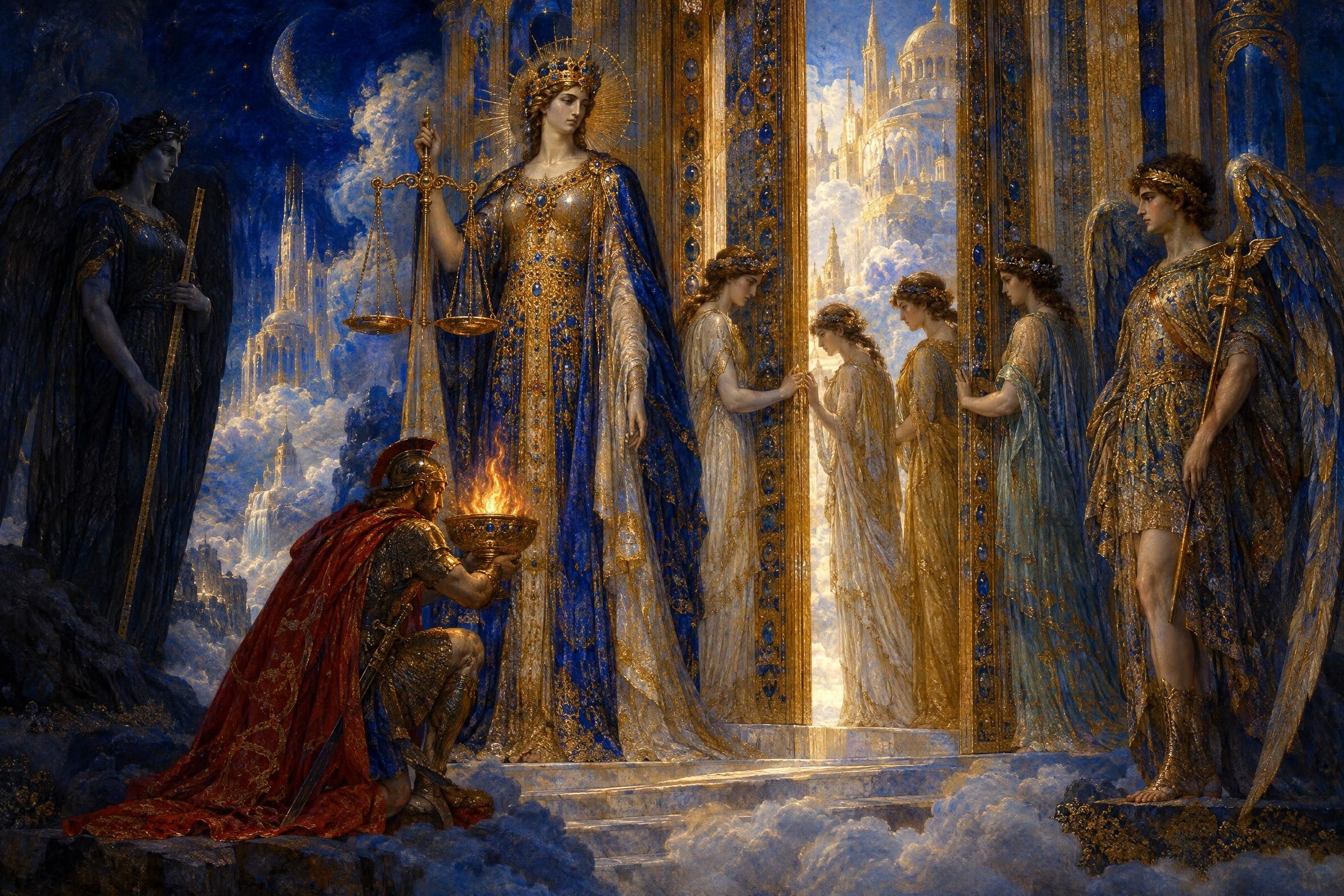
Before there were storms to divide, there was Themis. She was a daughter of Sky and Earth, born in the dark before they were parted, and something of each was in her: her father’s height and distance, her mother’s weight and patience. She held a pair of scales. Her parents had never been able to share anything; she was made to.
Zeus took her as his wife and seated her beside his throne, and she bore him the Horai — the Seasons, whose names are Good Order, Justice and Peace — and he set them to keep the cloud-gates of Olympus, to open them at the appointed hour and close them again. Themis’s counsel was law set down in advance. Once she warned the gods that the sea-nymph Thetis would bear a son greater than his father; and because the warning came before desire rather than after it, Zeus, who wanted Thetis, let her go. No son of his ever grew great enough to overthrow him.
So it is done still. When the bolt falls and Mars returns from the field with the fire, he does not choose where it goes. He lays it before Themis. She does not weigh it by mood, or by the glow of the day’s victory, or by fear of the next storm. Her law was written before this storm, and she reads from it.
At the hour the Horai open the gates, Hermes carries the fire out as she has ruled. A portion to Saturn’s field, to be ploughed in and grow. A portion to Hestia’s hearth, to be kept. A portion back to the altar, so that the sky may be offered to again.
And if any part of the household has swelled beyond its due — a field grown rank, a single tree grown so tall it shades the orchard — then Nemesis, whose name means distribution, comes with her measuring rod and takes back the excess. She is not cruel. She simply allows nothing to outgrow its share.
Then the gates close, the fire lies where the law has put it, and the next season begins.
The trading concept
Rules-based allocation and rebalancing. A strike is the most dangerous moment in the life of a portfolio, because it is when judgment is most flushed. The philosophy answers by taking the choice out of that moment. Where the proceeds of a convex win go — into the core, into the reserve, back into new premiums — is decided in advance, written down, and applied the same way every time.
The Horai are the cadence: allocation happens at fixed intervals, not whenever the mood strikes. Hermes is execution, carrying capital between the realms. Nemesis is rebalancing, trimming whatever has grown past its share, so that no single holding, however successful, comes to rule the whole. Themis herself is the law — the philosophy encoded as rules, which is what an automated system is.
Its shadow → Hermes at the Crossroads: the messenger who carries the fire is also the god of thieves, and every crossing costs something.
Further reading
- Hesiod, Theogony — Themis among the children of Ouranos and Gaia; her marriage to Zeus and the birth of the Horai.
- Homer, Iliad, Book 5 — the Horai who keep the cloud-gates of heaven.
- Pindar, Isthmian 8 — Themis’s warning about the son of Thetis.