The Farmer King
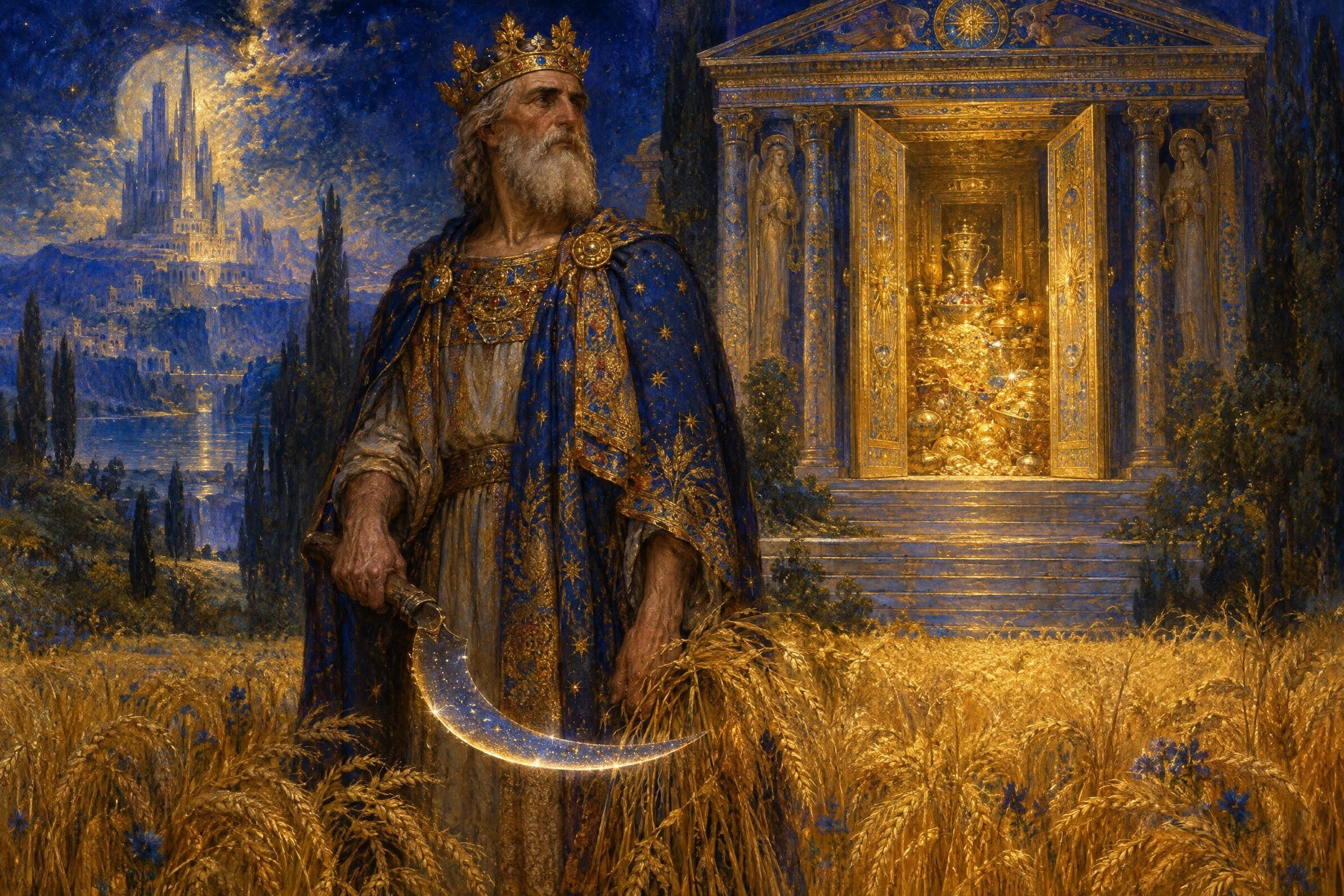
Saturn had been a king in the sky. He held the sickle his mother the Earth had made, and with it he had cut the Sky away and taken the throne. But his own son rose against him, as he had risen against his father, and Jupiter drove him out of heaven.
He fell a long way. He came down at last in Italy, among a scattered people who lived in the woods, gathering what they found and owning nothing. Saturn hid there — the Romans said the land was named Latium from latere, “to lie hidden” — and the exiled king did not try to win back the sky. He stayed on the ground and taught.
He gathered the scattered people together and gave them laws. He taught them to clear the land, to plough it, to sow in the right season and to prune the vine. And the sickle that had once cut the Sky became, in his hand, a tool for the harvest. The same blade. Only the work had changed.
Under him Italy had its Golden Age. The Romans never forgot it. They built him a temple at the foot of the Capitol, and inside it they kept the treasury of the Republic — the aerarium Saturni, the wealth of Rome stored in the house of the farmer.
But golden ages end. The poets said that Jupiter would not let the earth stay easy. He hid fire in the flint and put poison in the serpent, he shook the honey from the leaves and stopped the wine that ran in the streams, so that mortals would have to find the arts for themselves, by practice and by need. And they did. They learned to track the stars, to set snares, to split wood with wedges, to temper iron. Labor omnia vicit improbus — relentless labour conquered all.
Saturn’s gift was not the Golden Age. It was what was left after it: the plough, the calendar, the rule kept every year.
The trading concept
Discipline. Saturn governs the garden. His virtues are the unglamorous ones: rules, repetition, patience, the same work done in the same season whether or not anyone is watching. A core portfolio is not built by inspiration. It is built the way a farm is — by doing the right, ordinary thing again and again for a very long time.
The tried and true earns its trust by surviving. This is the Lindy effect: for things that do not wear out, every year they have lasted makes another year more likely. The plough and the calendar are very old, and they are still here. A rule that has held through many seasons deserves more trust than a clever one invented last spring.
And the golden age does not come back. Returns that came easily in one era are not promised in the next; what remains is labour, and the rule that is kept.
Its shadow → The Stone in Swaddling Clothes: the same Saturn, as Kronos, kept his rules so rigidly that he devoured his own children and swallowed a stone without looking.
Further reading
- Virgil, Aeneid, Book 8 — Evander tells of Saturn’s exile in Latium and the Golden Age.
- Virgil, Georgics, Book 1, lines 121–146 — Jupiter ends the easy age; “labor omnia vicit / improbus”.
- Macrobius, Saturnalia, Book 1 — Saturn in Italy and the treasury in his temple.
- Nassim Nicholas Taleb, Antifragile — the Lindy effect.