The Trees That Bear
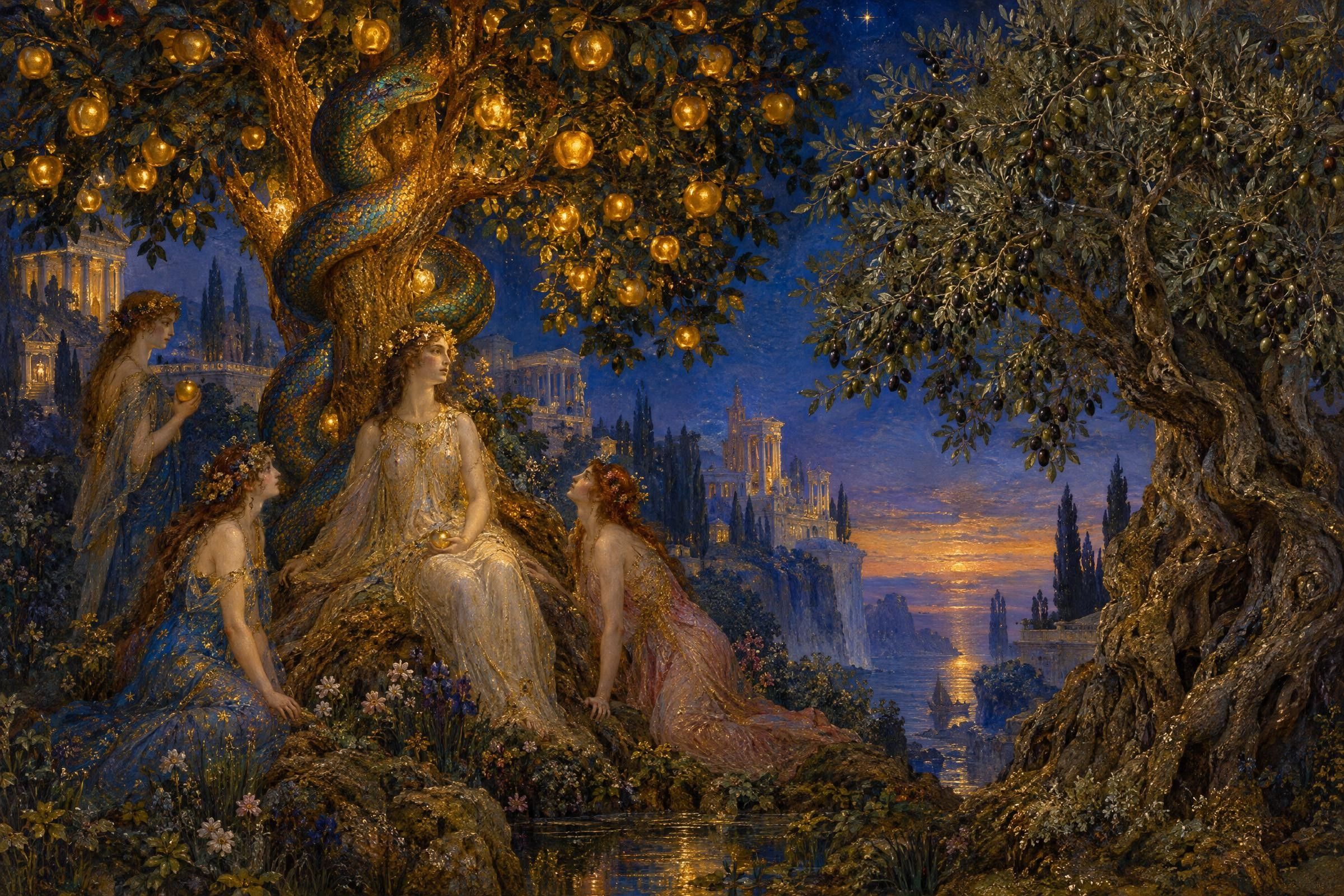
When Zeus married Hera, all the gods brought gifts. The Earth brought a tree.
Gaia raised it up out of her own ground, and its branches hung with apples of gold. Hera was not a goddess of fields or harvests, and she did not plant the tree in Olympus or eat its fruit. She was astonished by it, and she knew what it was worth. So she had it set in a garden at the far western edge of the world, where the sun goes down, and gave it into the keeping of the Hesperides, the daughters of the evening, and of a serpent that never slept, coiled around its trunk. The tree was not there to be cut or sold. It was there to bear.
Far to the east, in Attica, two gods once contested for a city. Poseidon struck the rock of the Acropolis with his trident, and salt water sprang up — a sign of power, and of no use to anyone who needed to drink. Athena planted an olive. The people chose the olive, and the city took her name.
An olive tree is not a quick gift. It grows slowly, and its first harvests are thin. A man who plants one plants it for his grandchildren. But once it is established it bears year after year, for generations, fruit and oil from the same old wood. When the Persians took Athens and burned the Acropolis, Athena’s olive burned with it. The next day, the Athenians said, a green shoot a cubit long had already sprung from the blackened stump.
The Greeks had a word for what a loan returns to its lender: tokos, the same word they used for a child, or for the young of a flock — offspring. Money lent was thought of as a parent, and what it yielded as something born of it, year after year, while the parent stayed whole.
The trading concept
Dividends and interest are fruit. Some holdings are kept not for what they might be sold for tomorrow but for what they bear, season after season, while the tree itself remains standing. The apples are picked; the tree is not cut.
This is the buy-and-hold holding, and it asks for two things that are hard to give: tending, and waiting. Like Athena’s olive, it is slow to start and its early harvests look small. Its value appears only over long spans of time, as yield is added to yield and the old wood keeps bearing. And the best of these trees are durable in a deeper sense — they can be burned in a bad year and still put out a shoot the next morning.
Guarding the tree matters as much as picking the fruit. Hera did not keep her apples on a public road.
Its shadow → Erysichthon’s Hunger: the king who felled the sacred grove for timber, and was left with a hunger nothing could fill.
Further reading
- Hyginus, Astronomica 2.3, after Pherecydes — Earth’s golden-apple branches, which Hera asked to have planted in her garden near Atlas; Apollodorus, Library 2.5.11, gives them as Earth’s wedding gift to Zeus.
- Herodotus, Histories, 8.55 — Athena’s olive on the Acropolis puts out a new shoot the day after the Persians burn it.
- Aristotle, Politics, Book 1 — interest as tokos, money born of money.